


How commutator quality affects DC motor performance
- Leandro Dias
- 8 hours ago
- 5 min read
The performance of a DC motor depends on several electrical, mechanical and operational factors. Among them, the commutator has a direct role in the stability of the assembly because it works in constant contact with the carbon brushes and participates in the conduction and commutation of electric current.
When the commutator is manufactured with quality, dimensional precision and proper finishing, it contributes to more stable operation, lower carbon brush wear, reduced sparking and greater operational reliability.
On the other hand, when this component presents material failures, surface irregularities or dimensional variations, the motor may suffer performance loss, overheating, premature wear and unexpected maintenance downtime.
What is the commutator in a DC motor?
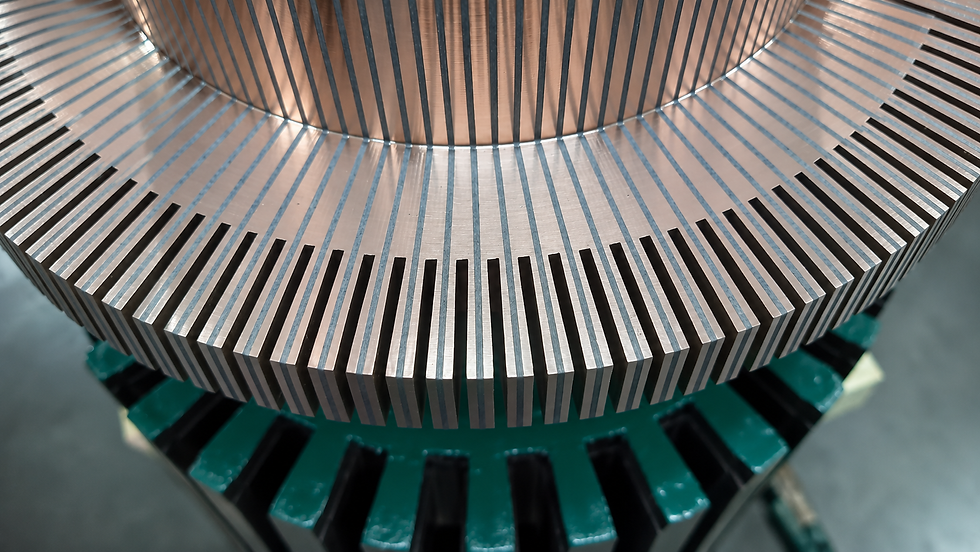
The commutator is a component found in DC motors and works in direct contact with the carbon brushes during motor operation. Its function is related to the conduction and commutation of electric current, helping the motor maintain continuous and organized movement.
Because it operates in an area of both electrical and mechanical contact, commutator quality directly affects the behavior of the assembly. When the component has good precision, suitable material and technical finishing, it contributes to greater stability, lower brush wear and better DC motor performance.
In some markets, this component may also be referred to as a collector for electric motors. Although the name may vary depending on the market or maintenance routine, its technical function remains essential for motor performance.
How does commutator quality affect DC motor performance?
The commutator is located in a critical area of the motor, where electrical and mechanical contact happen at the same time. This contact must occur in a stable way, with good current conduction, a proper surface and correct alignment with the carbon brushes.
When the commutator works within the correct specifications, the motor tends to operate with greater regularity. This reduces contact failures, lowers assembly wear and contributes to a longer service life for the equipment.
In industrial applications, traction motors or heavy maintenance operations, this care becomes even more important because the motor may operate under continuous load, temperature variations and severe operating conditions.
Material quality and electrical stability
Material quality directly influences the conductivity, mechanical resistance, thermal stability and durability of the commutator.
In DC motors, this care is essential because the component must withstand rotation, friction, temperature and constant contact with carbon brushes. If the material is not suitable for the application, contact failures, accelerated wear, deformation and efficiency loss may occur.
For this reason, material selection should not be treated as a minor detail. It is part of the technical foundation that allows the commutator to contribute to the performance and reliability of the DC motor.
Dimensional precision and contact with carbon brushes
Dimensional precision is one of the most important points for the correct operation of the commutator. Small measurement variations can cause irregular contact with carbon brushes, vibration, uneven wear and instability during operation.
In a DC motor, contact between carbon brushes and commutator must occur uniformly. When the component is outside the proper tolerances, the motor may show signs such as noise, sparking, overheating and premature brush wear.
That is why dimensional control during manufacturing is essential for the commutator to fit correctly into the assembly, operate with stability and contribute to more reliable performance.
Surface finishing and sparking reduction
The surface finishing of the commutator also directly affects motor performance. An irregular surface can compromise contact with carbon brushes and increase sparking during operation.
Excessive sparking may indicate failures in electrical contact, component wear, incorrect brush pressure or other problems in the assembly. Even so, the condition of the commutator must be carefully evaluated because its surface has a direct influence on this process.
Proper technical finishing contributes to:
more uniform contact with carbon brushes;
lower spark generation;
reduced wear;
more stable operation;
better motor performance;
greater reliability in the application.
How can an unsuitable commutator affect a DC motor?
An unsuitable commutator can compromise motor operation in several ways. In many cases, the failure noticed during operation does not begin in the entire motor, but in a component that was not manufactured or specified correctly.
The main problems that may occur include:
excessive sparking;
premature carbon brush wear;
overheating;
noise or vibration;
irregular contact;
performance loss;
recurring failures;
unexpected downtime;
increased maintenance costs.
In industrial applications, these problems can have even greater impact because equipment downtime may affect productivity, deadlines and operating costs.
The role of the commutator in carbon brush service life
Carbon brushes work in direct contact with the commutator. For this reason, any irregularity in the surface, dimensions or alignment of the component can accelerate carbon brush wear.
When the commutator has proper finishing and good dimensional precision, contact tends to be more uniform. This contributes to lower irregular friction, better brush seating and greater stability during operation.
A commutator with failures, however, can cause uneven wear, more frequent replacement needs and higher maintenance costs. In many cases, carbon brush durability is directly linked to the quality of contact with the commutator.
DC motor performance also depends on the application
Commutator quality must be analyzed together with the motor application. A motor used in industrial environments, traction systems or continuous-load applications requires a component compatible with the real operating conditions.
Some factors that must be considered include:
motor type;
rotation speed;
workload;
operating temperature;
operating environment;
type of carbon brush;
failure history;
need for replacement or custom development.
For this reason, a commutator should not be evaluated only by appearance or price. It must be compatible with the motor, the level of application demand and the real operating conditions.
Why choose a specialized manufacturer?
The choice of manufacturer also affects the final performance of the motor. A specialized manufacturer must understand not only the commutator as a component, but also its impact on the operation of the entire assembly.
This knowledge makes a difference mainly when the customer needs to replace a component, develop a special part or solve recurring failures in DC motors. In these cases, the manufacturer’s experience helps evaluate the project with greater technical criteria, guide the correct specification and reduce risks during application.
For this reason, working with a specialized supplier is essential to ensure that the commutator is produced based on real technical requirements, respecting the needs of the motor and the operation.
How WOD works with commutator quality
WOD manufactures commutators for DC electric motors, serving industrial applications, traction motors, maintenance operations and special projects.
With more than 25 years in the market, the company develops commutators with applied engineering, strict dimensional control, project traceability and attention to the factors that directly influence motor performance.
Each component is produced considering the importance of the commutator for electrical stability, proper contact with carbon brushes, wear reduction and durability of the assembly.
Commutator quality directly affects DC motor performance. Material quality, dimensional precision, surface finishing, application compatibility and manufacturer experience are factors that influence electrical stability, contact with carbon brushes and motor reliability.
When the commutator is manufactured correctly, it contributes to lower sparking, reduced carbon brush wear, fewer failures and greater operational safety.
If your company needs commutators for DC motors, WOD is prepared to develop and supply solutions with technical quality, specialized manufacturing and support for industrial and traction applications.
Need commutators for DC motors?
Contact WOD and request a quote.
WOD manufactures commutators for DC motors with dimensional control, traceability and technical support for industrial and traction applications.


Comments